OVERHEARD
Walking Performance: Perspective and the Embodiment of Listening
Work in development, scheduled for Q4 2027


1. Point of listening
We speak of a point of view. What is its equivalent in listening?
A turn of the head brings one sound closer and lets another slip away. As we move, the city gathers and disperses around us. A conversation enters earshot, footsteps pass behind us, a distant sound disappears around a corner.
During a volunteer orientation programme at the Hong Kong Blind Union, I walked blindfolded through the city, guided by another volunteer. Without sight, I became acutely aware of how I relied on sound to find my bearings. Sounds I might otherwise have passed over became clues to the space around me.
There is another kind of disorientation that sometimes arrives in a crowd: the sudden awareness that each person around us is living a life as vivid and continuous as our own. For a moment, the crowd ceases to be a background. Each person becomes a centre.
OVERHEARD brings these two experiences together: finding ourselves through sound, and imagining the world from a position other than our own. What might we encounter by listening through another person’s ears—and what would remain theirs alone?
2. Walking / listening as composition
In OVERHEARD, live sound is heard from different positions within a moving group. These listening positions—and the connections between them—become compositional materials.
For this initial stage, I focus on routing one listening perspective at a time, rather than layering several binaural feeds into a mesh. I designed the system to patch, switch and sequence these perspectives across the group, drawing on algorithmic composition and the routing logic of modular synthesis and contemporary classical music.
What passes through those structures is shaped by bodies. When my ears are broadcasting, a turn of the head or a choreographed movement changes what others hear. Participants can also introduce sounds through their voices, clapping or sound objects. Each person can listen, make sound, or become the ears through which others hear it.
Whose ears are shared, who listens through them, and when the connection changes become compositional decisions. Patterns can be precisely organised while the sounds passing through them remain live.
3. Strategies and matrix modes
One network, different rules for whose ears we hear through, four of the modes I'm experimenting with:
Broadcast — loudest / quietest
The group hears through the node receiving the loudest or quietest sound. Changes in sound level shift the shared listening position.
Sequenced listening
A listening position recurs like a motif; two positions alternate; a sequence gradually expands across the group. Order, repetition and timing create patterns.
Paired listening — Find my other half
Connected in pairs, participants find one another through listening.
Randomised listening — Find my ears
Whose ears are you hearing through? Participants follow sonic clues to locate their randomly assigned listening partner.
4. Audience node
Each participant carries a compact listening node: a phone, a RØDE audio interface, and binaural microphones and earphones. Each node transmits sound from the wearer’s position while receiving a feed routed through the network.
Its lightweight, inconspicuous form is a dramaturgical choice. I want the equipment to sit within everyday movement through the city, encouraging active listening rather than active use of a digital device. Changes in sound can transform an otherwise ordinary-looking encounter without drawing attention to the machinery behind it.
A custom-coded app detects nearby Bluetooth Low Energy (BLE) anchors placed along the route. These provide proximity cues that can trigger events or changes in the listening connections.
5. Performer node
A dedicated router connects the listening nodes to a central system. Ableton Live handles sound processing and musical events; Max/MSP acts as the audio-routing matrix. An iPad interface gives me control over both during the walk.
Through this interface, I select and redirect feeds, move between programmed sequences and live interventions, and respond to the group while remaining physically present as a performer.
6. Designing routes / zones
The route is a score of distances, thresholds and encounters: where we gather, where we disperse, and where a change in listening might alter our sense of a place.
I’m not looking for a neutral space. I’m drawn to places whose meanings feel less immediately prescribed—not because they are empty of history, but because they allow listening and interaction to become the starting point, without the work being organised around their most established narratives.
The city brings sounds, movement, interruptions and other people that I don’t fully control. These, together with the sites’ existing uses and spatial conditions, remain active material in the work. A staircase arranges listeners at different levels; a corner or back alley separates what is heard from what is seen. These features offer structures for listening, movement and interaction.
Selected locations become zones within the performance, each offering a setting for particular modes or events. Alongside this route exploration, I am developing DIY instrument prototypes to test how performed sounds might enter these encounters.

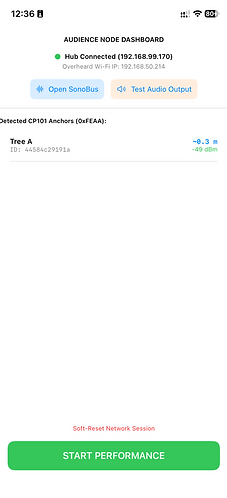


Core essentials for the audience node: a smart phone, a highly portable small-footprint audio interface, a pair of binaural earphones, and printed booklet


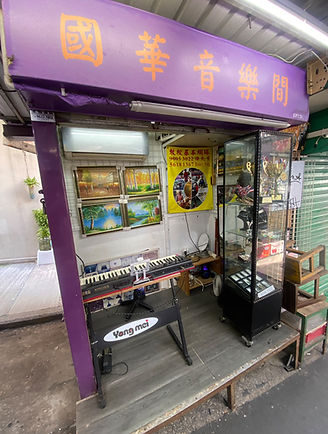


SELECTED WORKS
(2022 - present)
Parlance of Two: An Agreement
2026 · by Serene Hui x hirsk
Sound design / performance / visual design / installation
An Agreement is a live work structured as a legal contract read aloud. Through the appropriation of institutional language, it examines communication, trust and the often-invisible power relationships between artist, work and audience.
Presented as part of Parlance of Two, the work turns the terms of an agreement into material for performance. Repetition, personal anecdotes and poetic fragments interrupt the contract’s bureaucratic structure, unsettling its apparent certainty.
My contributions encompassed sound creation and performance, alongside visual design and installation. Working across these elements extended my involvement beyond sound alone, bringing different aspects of my practice into the conceptual framework of a live work.

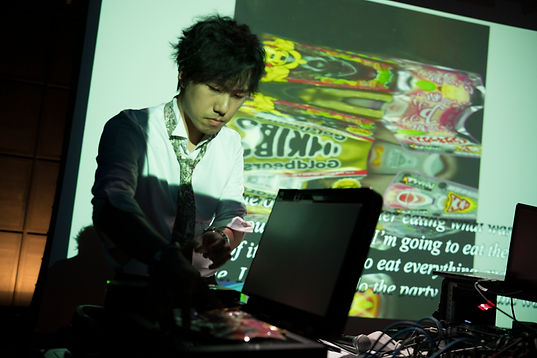
Full performance at JCCAC Black Box Theatre
FAR Away From Song
2026 · by Ivanhoe Lam
Sound design / installation
FAR Away From Song imagines a deceased brother’s response to the letters of his surviving sibling. Created by Ivanhoe Lam, it forms one half of the paired production Song From FAR Away || FAR Away From Song, presented simultaneously across two spaces.
While its companion draws on Simon Stephens’ play Song From Far Away, this work opens a perspective from the other side of loss. Movement, electronic music and multimedia bring the worlds of the living and the dead into proximity, exploring grief, farewell and the possibility of reunion.
I composed and performed live the electronic music (making use of live audio feeds and gestures) and designed sound installations, working within its interdisciplinary framework of movement, sound and image.


Full performance at Taikwun
The Invisible Skin
2025· Collaboration with Juggler Jason
Sound Design / Concept / Performance / Installation
Invisible Skin explores how a body is recorded, assembled and reprogrammed through technology—and where machine vision fails to read it. Juggling becomes a way to explore the gap between the performer and the shape the system recognises.
“Some footprints are so badly glued onto me as if they were my handiwork. Our shapes are recorded, assembled and reprogrammed. The system is working. Inside it is me…(._.)”


Full performance at Taikwun
Emotional Luggage
2022· hirsk x napp studio
Sound Installation
A 4.5m diameter ring of CNC-milled textures runs across the steps, on one hand, performing a collage of cities’ textural ground and, on the other, a human-scale vinyl record for one to create sound, if not music, by dragging the luggage across.
From orderly brick, tactile and stripe to chaotic wave and rock, the bumps and valleys are recorded by mic and sensors installed inside the luggage that subsequently synthesised into music tune and video projection onto the PVC ‘conveyor belt curtain’ in the background.
This is my first commissioned audio-visual installation. Motion of the dragged luggage case is captured as data by a gyroscope, and as audio by a wireless microscope, both hidden inside the luggage. Eurorack synthesizers in the middle generate endless melodic sequences. Both the audio and visuals created with Touch Designer are then manipulated in real-time by the luggage, effectively turning it into an instrument, or the playhead of a turntable.


Floral images processed in Touch Designer are projected onto a plastic curtain, as a reference to the conveyor belt at airports

The installation integrates with the venue’s staircase structure, harnessing gravity and slope to enhance interactive engagement.